• Admin/HR Login
  • Employee Login
Request a Demo
  • Platform
  • Solutions
  • Industries
    • Healthcare
    • Education K-12 & Higher-Ed
    • Energy & Utilities
    • Transportation & Distribution
    • Finance & Insurance
    • State & Local Govt
  • Success Stories
  • About Us
  • Schedule A Demo
  • Platform
  • Solutions
  • Industries
    • Healthcare
    • Education K-12 & Higher-Ed
    • Energy & Utilities
    • Transportation & Distribution
    • Finance & Insurance
    • State & Local Govt
  • Success Stories
  • About Us
  • Schedule A Demo
Leave Management Trends: What HR Needs to Know

Leave Management Trends: What HR Needs to Know

  • Posted by Margaret Kahng
  • On June 3, 2026
  • 0 Comments
Leave Management Trends: What HR Needs to Know

Employee leave of absence management has become one of the most complex and consequential responsibilities in HR. What was once a largely administrative function has evolved into a high-stakes, high-volume discipline that sits at the intersection of compliance, employee experience, and operational continuity.

The data makes this clear. Leave request volume is up. The number of leave types employers are managing is expanding. Regulations at the state and federal level continue to change. And the manual tools HR teams use are no longer sufficient.

This post draws on findings from Society for Human Resource Management (SHRM), Life Insurance Marketing and Research Association/Ernst & Young (LIMRA/EY), Disability Management Employer Coalition (DMEC), National Financial Partners (NFP), and HR.com to map where leave management stands today and what enterprise HR teams need to prioritize in 2026.


Key Takeaways

  • Leave benefits rank as the #2 most important benefit category, behind only healthcare (SHRM).
  • 73% of employers manage leave internally, and roughly two-thirds of those do it without software (NFP).
  • Half of employers spend 3+ hours on every individual leave case (NFP).
  • Mental-health-related leaves more than tripled in six years (ComPsych).
  • Organizations planning to use AI for compliance nearly doubled from 22% (2024) to 42% (2026) (HR.com).

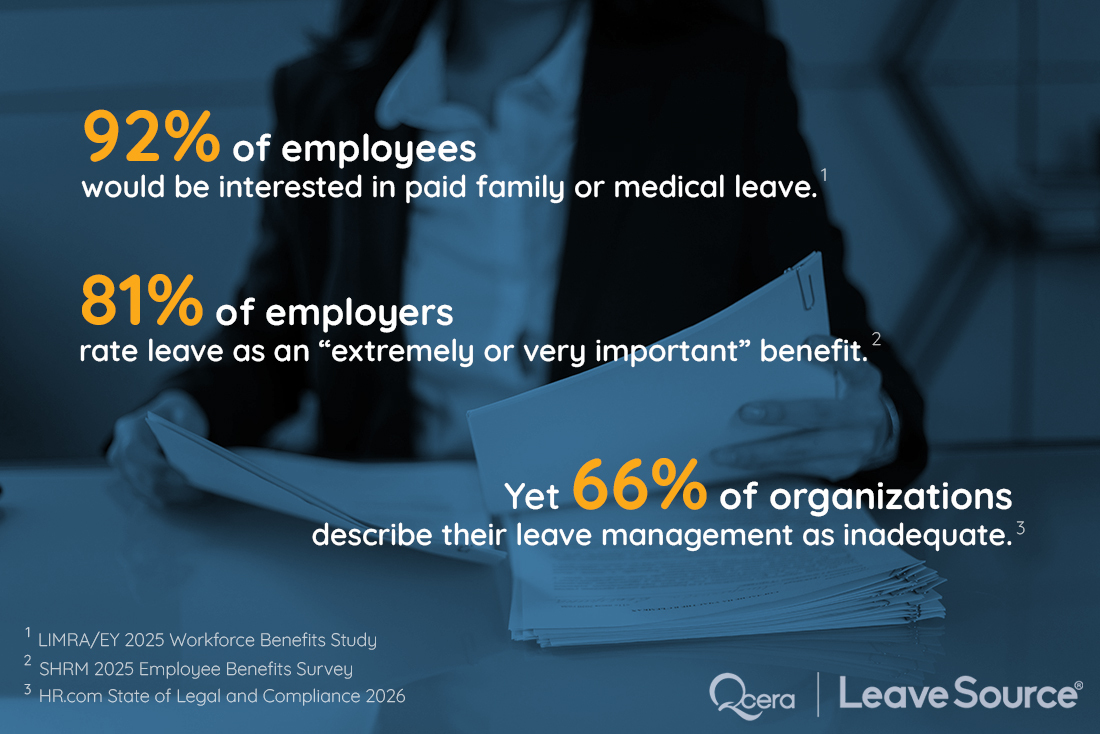
2026 Leave Trends Graphic - Qcera | LeaveSource®


Leave Has Become a Core Employee Benefit

For the fourth consecutive year, leave benefits tied for second as the most important employee benefit category in SHRM’s 2025 Employee Benefits Survey, rated as extremely or very important by 81% of employers. Only healthcare ranked higher.

LIMRA and EY’s 2025 Harnessing Growth: Workforce Benefits Study puts this in even sharper terms. Their research found that paid family or medical leave has crossed into what they call the ‘core four’: the small group of benefits employees consider essential alongside medical, dental, and vision insurance. 71% of all employers view paid family or medical leave as a critical benefit for the future. Among employees, 92% said they would be interested in this benefit.

The generational dimension matters here too. LIMRA’s study discovered that interest in paid family or medical leave is consistent across all four working generations (Gen Z, Millennials, Gen X, and Baby Boomers) though the reasons vary. Younger employees are often planning for growing families. Older workers increasingly need leave to handle caregiving responsibilities for aging parents. Leave is not a niche benefit; it is a workforce-wide expectation.


I’ve seen more leave of absence cases in the last 12 months than I’ve seen in the prior nine years combined.
– Benefits broker, LIMRA/EY 2025


Leave Volume Is Rising and Getting More Complex

More Requests, More Leave Types

Leave request volume has been climbing steadily. LIMRA states that 38% of employers have seen increases in absences since implementing a mandated paid family/medical leave program, and demand shows no signs of slowing.

The types of leave employers are being asked to manage are also multiplying. Beyond FMLA, ADA, and PWFA, employers are increasingly navigating state paid leave programs, caregiver leave, bereavement leave, mental health leave, and emerging categories like prenatal leave. LIMRA determined that midsize and large employers are now planning or considering five to seven different types of leave, and 37% are evaluating policy changes to accommodate intermittent and reduced schedule leave.

NFP’s survey data reflects this expansion directly. Only 30% of employers currently offer formal family caregiver leave — far too few given the scale of caregiving needs across the workforce. And while 59% of employers offer parental leave, 27% still distinguish between primary and secondary caregivers, creating both inequity and legal exposure.


More Requests, More Leave Types

Mental health has become one of the most significant drivers of leave volume across the workforce. LIMRA identified mental health and substance abuse benefits as a high priority for employees, particularly younger workers. ComPsych data showed that mental health-related leaves of absence more than tripled over six years.

This trend has direct implications for HR and leave teams. Mental health-related FMLA claims require the same eligibility determinations, certification management, and return-to-work coordination as any other leave type, but they are often harder to document, longer in duration, and more likely to involve intermittent or reduced schedule patterns. Managing them well requires both the right processes and the right tools.

Caregiver and Family Leave Are the Next Frontier

The “sandwich generation” (employees simultaneously caring for children and aging parents) is reshaping what leave programs need to cover. NFP determined that family caregiver leave remains underutilized by employers, with only 30% offering formal caregiver leave. Meanwhile, caregiving responsibilities are expected to intensify as workforce demographics shift. LIMRA noted that caregiving benefits are increasingly on the radar of employers looking to meet workforce needs across multiple generations.


The Compliance Gap: Employers Are Falling Behind

The Compliance Environment Is Getting Harder to Navigate

State and federal leave laws continue to evolve rapidly, and the regulatory environment going into 2026 is more complex than it has ever been. HR.com’s State of Legal and Compliance 2026 report found that 63% of HR professionals place benefits and leave-related compliance as their top compliance tracking priority, and 40% identify family and medical leave requirements as among the most difficult laws to comply with.

The fragmentation of state-level requirements is a particular challenge for multi-state employers. HR.com’s research noted fragmentation between federal and state requirements as one of the top barriers to keeping up with compliance changes. New Jersey’s recent NJFLA amendments, which take effect July 17, 2026, and expand employer coverage to organizations with 15 or more employees, are a recent example of how quickly state-level changes can affect an employer’s compliance posture.

The PWFA adds further complexity across all leave types. Covered employers cannot require an employee to take leave if another effective reasonable accommodation would allow that employee to keep working. This requirement demands individualized case review and thorough documentation for every accommodation case.

For HR teams managing leave manually, keeping pace with this regulatory environment is not realistic. NFP confirmed that one in five HR teams identifies compliance as their team’s weakest area. HR.com found that about two-thirds of organizations describe their compliance processes as inadequate.

Manual Processes Cannot Scale

Despite the rising volume and complexity of leave management, many organizations are still handling it without dedicated technology. NFP’s 2026 Leave Management Report found that 73% of employers manage leave internally, and of those, roughly two-thirds do so without software.

The cost of this gap is measurable. NFP revealed that half of employers spend three or more hours managing each individual leave case. Nearly two-fifths of HR teams spend more than a quarter of their entire workweek on compliance-related tasks, according to HR.com’s 2026 data. And only 49% of organizations agree that key compliance processes are automated.


Half of employers spend three or more hours managing each leave case.
– NFP 2026

The employee experience is also suffering. According to LIMRA, only 24% of workers who experienced a leave event described the process as very easy. When employees struggle to navigate leave, the impact on trust, retention, and engagement is felt.

The Shift Toward Technology Is Accelerating

The market is responding. DMEC’s annual Employer Accommodation and Leave Management Survey found that in 2025, a larger share of employers use technology to support internal leave management compared to 2023, reflecting a continued shift away from manual processes. LIMRA named growing regulatory complexity, limited internal resources, and the expanding number of leave types as the primary drivers pushing employers toward technology-enabled leave management solutions.

HR.com’s 2026 compliance report reinforces this: the proportion of organizations planning to use AI for compliance nearly doubled over two years, from 22% in 2024 to 42% today. Technology is no longer nice-to-have in leave management; it is becoming a competitive advantage and compliance necessity.


What Modern Leave Management Requires in 2026

Based on the data, enterprise HR and leave teams in 2026 need leave management capabilities that address the following:

  • Centralized case management across FMLA, ADA, PWFA, state paid leave, and employer policy in one system

  • Automated eligibility and entitlement tracking that keeps pace with changing state and federal requirements

  • Intermittent leave tracking with accurate entitlement counting across concurrent leave types

  • Employee self-service portal that reduces inbound HR inquiries and gives employees a transparent, accessible leave experience

  • Document management system that centralizes certifications and medical documentation linked directly to each case

  • Integration with HRIS, payroll, timekeeping, and scheduling systems so leave data flows accurately across the organization

  • Full audit log that supports defensible compliance decisions across every case type

Our guide How to Choose the Best Leave Management Software for Your Business Size and Industry breaks down what to look for in a leave management platform based on your organization’s operational needs.


Frequently Asked Questions

What are the biggest leave management trends for 2026?

Rising leave volume, an expanding number of leave types (five to seven for most midsize and large employers), mental health as a top driver, intensifying caregiver demand, fragmented state-level compliance, and an accelerating shift from manual processes to technology and AI.

Why can’t HR teams keep managing leave manually?

Half of employers already spend 3+ hours per leave case, two-thirds call their compliance processes inadequate, and only 49% have automated key compliance steps. As volume and regulatory complexity grow, manual tracking creates compliance risk and a poor employee experience.

Why can’t HR teams keep managing leave manually?

HR teams cite family and medical leave (FMLA), the PWFA, and the fragmentation between federal and rapidly changing state paid-leave programs as the most difficult, especially for multi-state employers.


Leave Management Is No Longer a Back-Office Function

The data from SHRM, LIMRA/EY, DMEC, NFP, and HR.com tells a consistent story: leave has moved to the center of the employee benefits conversation, leave volume and complexity are rising, and organizations that are still managing this work manually are carrying risks they may not fully recognize.

For HR leaders and leave teams, 2026 is the year to take a hard look at whether your current tools and processes can support the program your workforce expects and your compliance obligations require.


Ready to modernize your leave program?

Connect the Qcera | LeaveSource® team
.

Qcera | LeaveSource® is the all-in-one leave and accommodations platform trusted by enterprise HR teams to manage the full leave life cycle from the employee’s first request to their return to work.


Sources

SHRM 2025 Employee Benefits Survey, shrm.org/benefits

LIMRA/EY Harnessing Growth: Workforce Benefits Study 2025, LL Global, Inc.

2025 DMEC and Spring Consulting Group Employer Accommodation and Leave Management Survey, dmec.org

ComPsych Mental Health Leaves of Absence Surge Press Release, February 29, 2024, compsych.com/press-release/mental-health-leaves-of-absence-surge-increasing-33-over-prior-year/

2026 NFP U.S. Leave Management Report, NFP, an Aon Company

HR.com State of Legal and Compliance 2026, HR.com Research Institute


Legal disclaimer: This post is intended for informational purposes only and does not constitute legal advice. HR teams should consult legal counsel regarding the applicability of specific leave laws to their organization.


0 Comments

Leave Reply Cancel reply

Your email address will not be published. Required fields are marked *

Recent Posts
  • Leave Management Trends: What HR Needs to Know
  • A Complete Buyer’s Guide to Choosing Absence Management Software
  • Find the Right Solution for Your Leave Program
  • How to Choose the Best Leave Management Software for Your Business Size and Industry
  • Maine Paid Leave Starts Benefit Payments May 1, 2026
Recent Comments
    Archives
    • June 2026
    • May 2026
    • April 2026
    • March 2026
    • February 2026
    • November 2025
    • October 2025
    • September 2025
    • May 2024
    • March 2022
    • February 2022
    • July 2016
    • July 2015
    • June 2015
    • May 2015
    • April 2015
    • November 2014
    Categories
    • Absence Court Case
    • Absence Management
    • Absence Management Software
    • Absence Software
    • Absence Tracking
    • ADA
    • ADA Disability
    • ADA Software
    • Americans with Disabilities Act
    • blog
    • Breastfeeding
    • CASES
    • CFRA
    • Connecticut
    • Family Medical Leave Act
    • FMLA
    • FMLA Abuse
    • FMLA Administration Software
    • FMLA Administrative Software
    • FMLA Compliance
    • FMLA Intermittent Leave
    • FMLA Leave
    • FMLA Management
    • FMLA Management Software
    • FMLA News
    • FMLA Software
    • FMLA State Paid Leave Law Update
    • FMLA Tracking
    • FMLA Tracking Software
    • FORMS
    • HR – Human Resources
    • LAW
    • Leave
    • Leave Management Software
    • Leave Management System
    • Leave of Absence
    • Leave of Absence Case Studies
    • Leave of Absence Management
    • Leave of Absence Management Software
    • Leave Software
    • LOA
    • Maternity Leave
    • Parental Leave
    • Paternity Leave
    • PDL
    • People Management
    • Pregnancy
    • Same Sex
    • Total Absence Management
    • Uncategorized
    • Workers Compensation
    Meta
    • Log in
    • Entries feed
    • Comments feed
    • WordPress.org
    About Qcera

    Qcera is the leading provider of software and services for FMLA and absence management. Since 2000, the Los Angeles based company has been best in class in customer service and offers a feature-rich solution for the complex issues surrounding leave of absence management.

    A Complete Buyer’s Guide to Choosing Absence Management Software

    Previous thumb
    Scroll
    Qcera | LeaveSource®
    • Home
    • Platform
    • Solutions
    Who We Serve
    • Industries
    • Healthcare
    • Education K-12 & Higher-Ed
    • Energy & Utilities
    • Transportation & Distribution
    • Finance & Insurance
    • State & Local Govt
    Reference
    • About Us
    • News
    • LeaveSource.com
    • Privacy Policy
    • Accessibility
    © Qcera.com | All Rights Reserved